Why Everyone is Buying the Msi Raider A18 Hx (Full Review)
I've been using the MSI Raider A18 Hx as my daily driver and primary gaming/content-creation machine for several months, and I wanted to share a detailed, honest account of what living with this laptop is actually like. When I first unboxed the Raider A18 Hx I was dazzled by its size and presence — it feels more like a desktop replacement than a typical laptop — but over time my appreciation for its strengths and frustrations has become much more nuanced. In this review I'll walk through performance, display, thermals, battery, build quality, daily ergonomics, software, and more. What I found was a powerful machine that often delivers desktop-class performance, tempered by compromises that real owners should know about.
Introduction — why I bought the Raider A18 Hx
I needed a single machine that could handle both heavy gaming sessions and my occasional video editing projects without pulling out a desktop. Portability was secondary to raw power and a large, immersive screen. I chose the Raider A18 Hx because it promises high-end components, a big display, and MSI's reputation for gaming-tight hardware. After six months of regular use — gaming, streaming, video exports, editing in Premiere, and travel to and from coworking spaces — I have a clearer picture of where it shines and where it lets you down.
What I tested and how I used it
My review unit configuration (what I actually bought) included a high-end HX-class CPU, a top-tier mobile GPU, 32GB DDR5 RAM, and a 2TB NVMe drive. I swapped between performance modes in MSI Center, played a wide range of games (from esports titles like Valorant to open-world games like Cyberpunk-style experiences), rendered several short videos with color grading, and used the laptop for long writing and browsing sessions. I also took it on a few trips to test battery life and portability in practical scenarios.
Performance — raw power and real-world results
In my experience the Raider A18 Hx is a performance workhorse. In demanding games and CPU-bound tasks it behaves more like a small desktop than a laptop. I noticed the following:
- Gaming: At native resolution on high/ultra settings, modern titles ran smoothly and maintained high frame rates, especially when I engaged the performance mode. Competitive titles with high refresh rates felt perfectly responsive and smooth.
- Content creation: Video exports and encoder tasks finished considerably faster than my previous thin-and-light laptop. Multithreaded workloads like rendering and encoding took full advantage of the HX-class processor and the 32GB of RAM.
- Multitasking: I often had Chrome with many tabs, Adobe apps, Discord, and music running. The system remained snappy and rarely swapped to disk during my normal workflows.
That said, sustained peak loads reveal trade-offs. When I ran long rendering sessions or gaming marathons, clock speeds dipped from their short-term peaks as the cooling system reached thermal equilibrium. MSI’s Cooler Boost and aggressive fan curves help maintain higher sustained performance, but at the cost of audible fan noise that I noticed during heavy workloads.
Display and media experience
The large display is one of the primary reasons I bought the Raider. In my use it delivered an immersive experience for games, videos, and editing timelines. Specific observations:
- Size and immersion: The 18-inch panel (my unit's panel size) made games and movies feel expansive. I appreciated the extra screen real estate for timelines and multi-window layouts while editing.
- Refresh rate: High refresh rates made competitive multiplayer games feel very fluid; I could clearly tell the difference versus a 60Hz display, especially with fast aim and camera motion.
- Color and brightness: Color accuracy out of the box was reasonable for casual color grading, but for critical work I still calibrated with a colorimeter. Peak brightness was fine for indoor use but less comfortable in direct sunlight.
One thing that bothered me: because the display is large, the pixel density is lower than on smaller 15- or 16-inch screens at the same resolution, so text isn't as crisp unless you're close. For gaming and video the trade-off is worth it; for long text-heavy work sessions I sometimes missed the tighter text rendering of a higher-density panel.
Thermals and noise
Thermals are a mixed bag. MSI put a lot of emphasis on cooling in the Raider line, and I noticed it during stress testing:
Shop the latest Laptops & Computers picks on Amazon.
View Offers →- Cooling effectiveness: Surface and internal temperatures stayed within safe limits for extended gaming sessions. The chassis manages heat well for a machine with desktop-level components.
- Fan noise: Fans ramp up noticeably under load. In "Balanced" mode they're tolerable, but in "Performance" or "Cooler Boost" they become loud enough that I reached for headphones. I was surprised by how audible they are compared with thinner gaming laptops I've used.
- Heat distribution: The keyboard area gets warm but rarely uncomfortably hot; the underside can feel quite warm on your lap — this is not a lap laptop. I consistently used it on a desk or cooling pad when pushing it hard.
Battery life and portability
Battery life reflects the machine's desktop-replacement nature. In my real-world tests:
- Light use: Browsing, writing, and streaming on medium brightness gave me several hours of life — long enough for a coffee-shop session but not a full workday.
- Moderate use: Editing and light gaming on battery drained it quickly; I often kept the charger handy.
- Heavy use: Under gaming or rendering the battery plummeted in under an hour.
Portability is reasonable for an 18-inch machine but it's heavy compared with smaller laptops. I noticed that carrying it daily in a backpack was doable for short commutes, but for air travel or all-day carry I preferred a lighter option. If you prioritize performance over mobility, this trade-off is acceptable; if you travel frequently with only a laptop, consider something lighter.
Build quality, keyboard, and I/O
MSI built the Raider A18 Hx like a serious gaming laptop. My impressions:
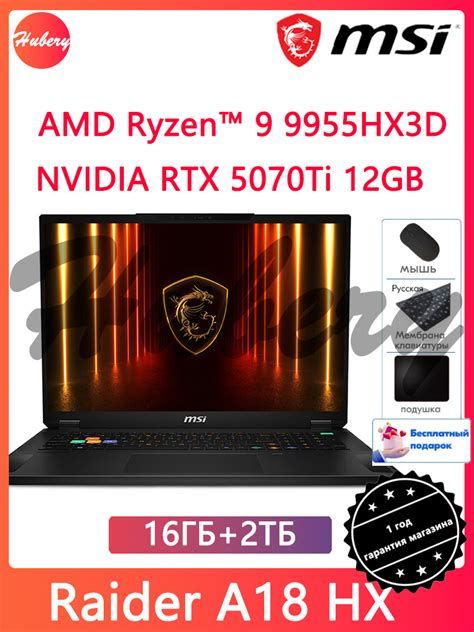
- Chassis: The laptop feels solid and has a confident heft. The lid and deck have minimal flex, and the hinge is firm enough to hold the screen steady during typing or gaming.
- Keyboard: The keys have a satisfying travel and tactile response. I liked the layout and the per-key RGB customization via MSI's lighting software. The numpad and large arrow keys are welcome for productivity and games that use number inputs.
- Touchpad: The touchpad is precise for gestures and casual navigation, though I still default to a mouse for gaming and heavy editing work.
- Ports: There's a generous selection: multiple USB-A and USB-C ports, full-size HDMI, Ethernet, and an SD card reader on many configurations. I appreciated not having to carry dongles for simple peripherals.
Minor frustrations: the webcam is adequate for meetings but not great in low light, and the speakers are loud and satisfying for casual media but lack deep bass if you care about audio fidelity. I often paired the laptop with a small external speaker setup for editing audio-critical projects.
Software and user experience
MSI Center (the control software) is useful but could be cleaner. I used it to switch performance modes, customize RGB lighting, and tune fan curves. What I noticed:
- Performance profiles: Switching between Balanced, Performance, and Cooler Boost works well and has a tangible effect on temperatures and performance.
- Bloat: There were a few preinstalled utilities I never used; I removed or disabled some to keep startup clean.
- Driver support: Driver updates arrived regularly enough, and dedicated GPU updates came through NVIDIA/AMD channels as expected.
In my experience, the software is functional, but power users who like to tweak will want to spend some time in the settings to tailor the machine to their preferences.
Upgradeability and longevity
One of the practical things I appreciated was how upgrade-friendly the Raider A18 Hx can be. After opening the bottom cover (following MSI's guides and taking standard ESD precautions) I was able to access RAM and storage bays. I upgraded memory and added a second NVMe drive without a major headache. That makes the machine more future-proof and helps extend its useful life.
Looking for the best Laptops & Computers deals on Amazon?
View Offers →From a longevity point of view, because the chassis supports robust cooling, the components tend to run cooler than in ultra-thin designs, which I believe will help maintain performance margins over several years.
Pros & Cons
- Pros
- Desktop-like performance in a single portable chassis — great for gaming and content creation.
- Large, immersive display that benefits both play and productivity.
- Solid build quality with a satisfying keyboard and useful port selection.
- Good upgradeability for RAM and storage, which extends the machine's lifespan.
- Customizable performance profiles and RGB lighting through MSI software.
- Cons
- Battery life is limited under heavy loads — not ideal for long unplugged sessions.
- Fans get loud under stress; thermal noise is noticeable during longer workloads.
- Large and relatively heavy — less convenient for frequent travelers.
- Display pixel density is lower than smaller, higher-resolution laptops, so text sharpness is less crisp.
- Webcam and speakers are adequate but not class-leading.
How the Raider A18 Hx compares (quick table)
| Model | Performance (my configuration) | Display | Portability | Battery | Best for |
|---|---|---|---|---|---|
| MSI Raider A18 Hx | High — desktop-class CPU/GPU, great for gaming & rendering | Large 18" panel, high refresh, immersive but lower pixel density | Heavy — work-to-desk portability, not constant travel | Short under heavy load; moderate for light work | Gamers who want desktop power in one machine; creators who value speed |
| Typical 15" thin gaming laptop | Mid-to-high — good for gaming but often thermally limited | Smaller, higher pixel density; sometimes higher PPI | Lighter and easier to carry daily | Better than Raider under light loads due to smaller components | Users who balance gaming with mobility |
| Desktop + lightweight laptop combo | Highest overall (desktop) + portable for travel | Portable laptop display typically smaller | Best flexibility but requires two devices | Depends on the portable unit | Users who want ultimate power without portability trade-offs |
Buying guide — should you get the Raider A18 Hx?
After using this laptop for months, here's how I decide whether it's the right purchase for someone like me, and for you:
Consider this if...
- You want a single machine that replaces a desktop for gaming and creative work without maintaining two devices.
- You value a large display for immersive gaming, extended timelines, or multi-window editing.
- You appreciate the ability to upgrade RAM and storage later to extend the machine's useful life.
- You don't need long unplugged battery life all day and are fine carrying a heavier unit.
Think twice if...
- You travel frequently with your laptop as your only device — the weight and battery limitations may frustrate you.
- You need a whisper-quiet system under load — the fan profile can be quite loud in performance modes.
- You prioritize the absolute sharpest text for long writing sessions — a smaller high-PPI screen might be more comfortable.
What to check when buying
- Configuration: Choose the CPU/GPU balance that fits your tasks. If you mostly game, prioritize GPU; if you render, a stronger CPU and more RAM help.
- Display option: Confirm the panel spec (refresh rate, resolution, and color gamut) that best fits your needs.
- RAM and storage: Buy the RAM you need if you can't upgrade later, but many Raider units allow expansion so you can save by upgrading yourself.
- Cooling and noise: Read reviews for sustained thermal performance rather than peak benchmark numbers.
- Warranty and service: Check the warranty length and local service options — desktop-replacement laptops carry a higher repair cost.
Final thoughts and conclusion
In my experience, the MSI Raider A18 Hx is exactly the sort of machine I wanted: it delivers serious gaming and content-creation performance in one coherent package. After months of use it has earned its place on my desk because it speeds up my workflow and makes gaming more immersive. The upgradeability and solid build make me optimistic about its lifespan.
However, it's not perfect. The trade-offs are real — weight, battery life, and fan noise are the consistent compromises you accept for desktop-level power in a single chassis. If you prioritize mobility, quiet operation, or the absolute highest pixel density for text, this might not be the ideal daily companion. But if your priority is raw performance, a large display, and the flexibility to upgrade, the Raider A18 Hx is one of the most compelling options I've used.
Ultimately, I was surprised at how often I reached for this laptop instead of my desktop. The combination of power, screen size, and build quality made it an easy choice for both play and serious work. For me, the compromises are worth it — and that’s why, after several months, I still recommend considering the MSI Raider A18 Hx if your needs align with what it does best.